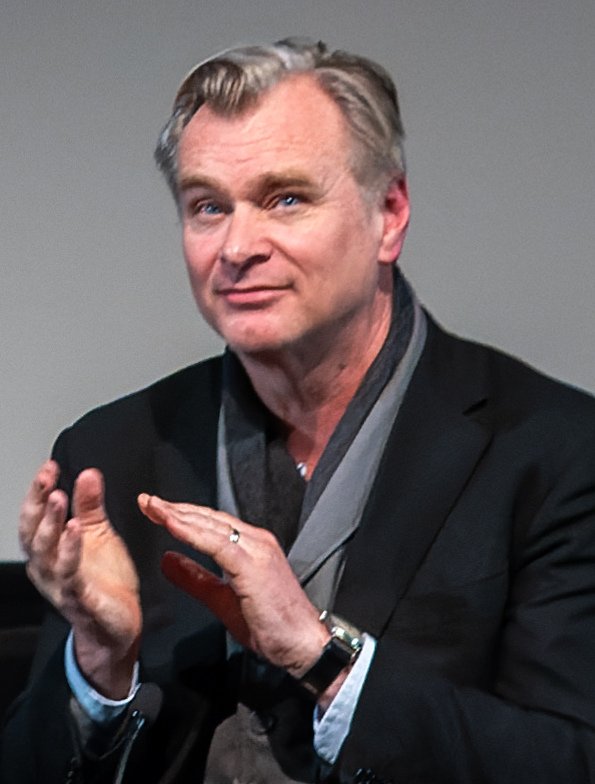
Christopher Nolan

Christopher Nolan

Film director, screenwriter and producer

Explore Christopher Nolan's biography, career highlights, notable work and connected film and television credits.

Photo: Raph_PH / CC BY 2.0
Career overview

About Christopher Nolan

Christopher Nolan is a British-American filmmaker whose work combines large-scale production with stories about memory, identity, time and moral responsibility. He developed his reputation through independent crime films before directing studio blockbusters that retained unusual structures and practical filmmaking methods. Nolan frequently writes or co-writes his films and produces them with Emma Thomas through Syncopy. His career is important because it demonstrates that original or formally ambitious stories can be presented to a mass theatrical audience without abandoning complexity.

Known for: The Dark Knight trilogy, Inception, Interstellar, Dunkirk and Oppenheimer

🎬 Filmography

In-depth guide

From independent filmmaking to the Batman trilogy

Nolan's early feature Following was made on limited resources and already showed his interest in fractured chronology, unreliable information and characters who construct identities for themselves. Memento expanded those ideas through a narrative arranged around a man unable to form new memories. Its structure was not decoration; it placed the audience close to the character's uncertainty. Insomnia then showed Nolan working with established actors and a studio production. Batman Begins marked a much larger transition. Rather than treating the superhero only as spectacle, the film built its story around fear, training, institutions and the decision to create a public symbol. The Dark Knight widened that approach into a crime epic concerned with order and moral compromise. The trilogy's success gave Nolan unusual freedom within mainstream filmmaking and helped make director-led event films central to his public identity.

Verified Jul 16, 2026

Time, perspective and practical scale

Nolan's films repeatedly ask how people understand time. Inception uses different dream levels moving at different speeds. Interstellar connects cosmic distance with the emotional cost of time passing. Dunkirk presents one evacuation through overlapping periods on land, sea and air. Tenet turns temporal movement into part of its action grammar, while Oppenheimer contrasts subjective experience with a later political process. These structures reward attention, but their purpose is usually emotional or ethical rather than puzzle-solving alone. Nolan also favours large-format film, real locations, constructed sets and practical effects where possible. Digital work remains part of the finished films, yet physical elements give actors and cameras something tangible to respond to. Sound and music are equally important, often creating momentum before the audience fully understands every piece of information. The result is cinema designed to be felt at scale while still inviting discussion after the story ends.

Verified Jul 16, 2026

Actors, recurring collaborators and moral pressure

Nolan has worked repeatedly with performers including Michael Caine, Cillian Murphy, Christian Bale and Tom Hardy. His ensembles often mix actors associated with leading roles and performers who can establish authority quickly in supporting parts. Characters are commonly professionals operating under pressure: detectives, scientists, soldiers, engineers, magicians or criminals. Their skill does not protect them from obsession or self-deception. The Prestige turns professional rivalry into personal destruction. Inception places a technical team around a leader whose unresolved grief threatens the mission. Oppenheimer uses close subjective filmmaking to examine scientific achievement, political power and consequence. Nolan's Academy Awards for directing and producing Oppenheimer recognised both an individual film and a long career spent bringing demanding subjects to wide audiences. A useful viewing route begins with Memento, continues through The Dark Knight and Inception, and then compares Dunkirk with Oppenheimer.

Verified Jul 16, 2026

How to approach Christopher Nolan's filmography

Viewers do not need to decode every structural detail on a first viewing. Nolan normally provides a clear emotional line even when chronology is complicated. Memento is the best compact introduction to his use of memory and perspective. The Prestige adds rivalry and misdirection. The Dark Knight demonstrates his approach to a major franchise, while Inception presents an original action story on a similar scale. Dunkirk offers his most stripped-down historical narrative, and Oppenheimer combines biography, politics and subjective experience. CineVault connects Nolan to acting, writing, directing and production credits where imported data supports those roles. This broader credit view is more accurate than describing him only as a director.

Verified Jul 16, 2026

Frequently asked questions

What themes commonly appear in Christopher Nolan's films?

His films often explore time, memory, identity, obsession, moral responsibility and the limits of a person's perspective.

Who produces Christopher Nolan's films with him?

Emma Thomas is his long-time producing partner, and they operate the production company Syncopy.

For which film did Christopher Nolan win his first directing Oscar?

He won the Academy Award for Best Director for Oppenheimer.

Follow the filmography

Continue exploring Christopher Nolan

Use verified credits and connected titles to understand the career without relying on biography text alone.

Movie library

Browse films and open connected cast and crew records.

Browse movies

Series library

Explore television profiles, seasons and episodes.

Browse series

Source transparency

Biography sources and licenses appear on this page when they have been recorded.